Gas heats most homes here
Utility gas heats 39.5% of occupied homes in Northampton County, more than any other fuel. Electricity comes in second at 31.3%, with fuel oil and propane making up most of the rest.
Takes about a minute. No obligation.
Utility gas heats 39.5% of occupied homes in Northampton County, more than any other fuel. Electricity comes in second at 31.3%, with fuel oil and propane making up most of the rest.
If your home heats with gas, a mini-split usually goes in alongside the furnace rather than replacing it, handling a room or a zone the ductwork doesn't reach well. For a home already heating with electricity, it can take on more of the job.
NOAA nClimDiv, 1991–2020 normals
Northampton County sees damaging wind, hail, and a winter storm or two most years.
None of that calls for anything beyond a correctly sized mini-split, installed to hold up outdoors.



Northampton County falls in climate zone 5A, a cool zone where the heating load matters more than the cooling load. Any mini-split installed here, ductless or not, has to meet the federal split-system heat pump minimums: at least 14.3 Btu of cooling delivered for every watt-hour used, and at least 7.5 Btu of heat for every watt-hour in winter. That standard applies to units built from January 1, 2023 on, and it's the same number whether the house is in Bethlehem or somewhere warmer. A unit that clears it is built to do real work on a cold night, not just take the edge off a mild one.
Summer here runs about three months, June through August, with afternoon highs averaging 82°F and a dew point around 62°F that makes the air feel heavier than the number alone suggests. That's a normal cooling load, not a heavy one. A correctly sized mini-split at the standard efficiency ratings handles it without trouble.
Find a contractor
Half the homes in Northampton County were built in 1971 or earlier. An older home often means older wiring, and the circuit a mini-split needs may not already be there. It also means the walls may not open up the way they would in new construction, which matters for where the line set can run between the outdoor unit and the indoor head. None of that rules out a mini-split. It just means the install has to work with the house as it is, not as a blank slate.
A contractor figures the load by looking at the square footage of the space, how many windows it has, which way they face, how well the walls and attic hold heat, and what else is already generating heat in that room. That calculation points to a specific unit capacity. Skip it and guess from square footage alone, and the unit is wrong before it's even mounted.
Too big, and the unit cools the air fast then shuts off before it pulls the moisture out, leaving the room cold and clammy. Too small, and it runs flat out without ever reaching the set temperature, which wears the compressor down well before its time. Either way the fix isn't adjusting the thermostat. It's having the load calculated right before the unit is bought.
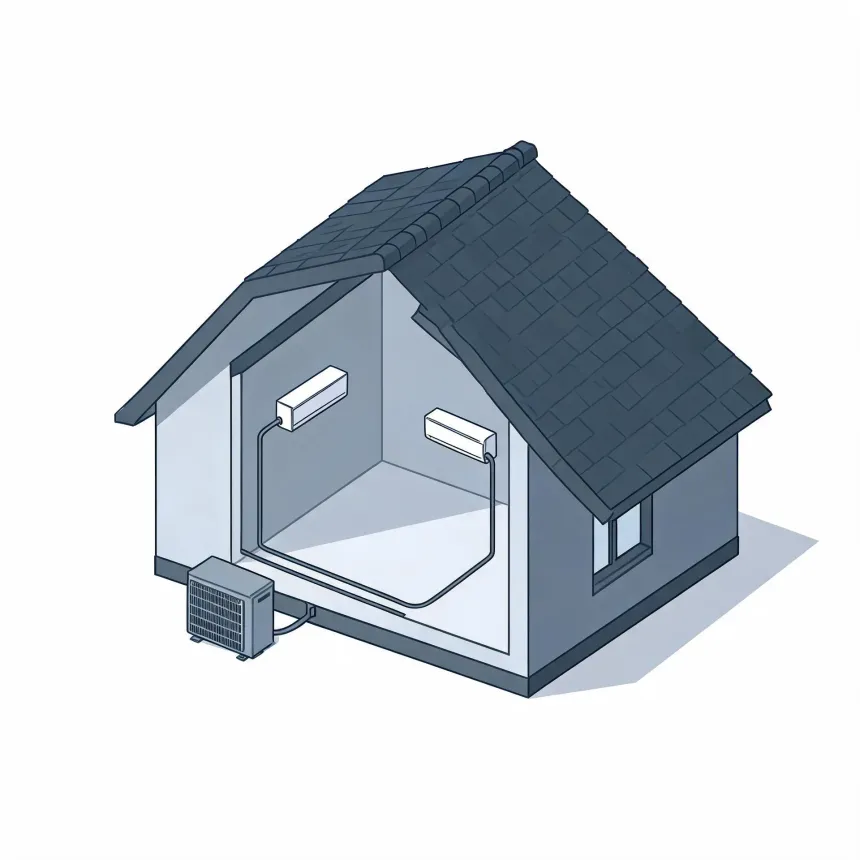
The unit itself is only part of what you're paying for. A single-zone system costs less than a multi-zone setup running two or three indoor heads off one outdoor compressor, since each added head means more labor, more line set, and another spot where the wall has to be opened up. Where the outdoor unit can sit matters too. A short, straight line set run between indoor and outdoor keeps the job simple, while a run that has to go up through a wall cavity or around framing takes more time and more material. Electrical work adds to it as well. A mini-split needs its own dedicated circuit, and if the panel has room and a circuit can be run short and direct, that's a quicker job than one where the panel is full or the wiring has to travel a long way. Mounting conditions count for something too. A straightforward wall mount on an exterior wall goes faster than a ceiling cassette or a unit that needs extra support or a condensate pump to get the drain line where it needs to go.
Electricity here runs 18.98 cents per kilowatt-hour, above what a lot of the country pays. That doesn't change what size unit this job needs. A mini-split sized to the room, at the standard federal efficiency minimums, is still the right call. Running costs follow from the rate and how much the unit runs, not from buying something bigger or pricier than the load calls for. Oversizing doesn't save money here. It just costs more up front and still cycles the way an oversized unit does anywhere.