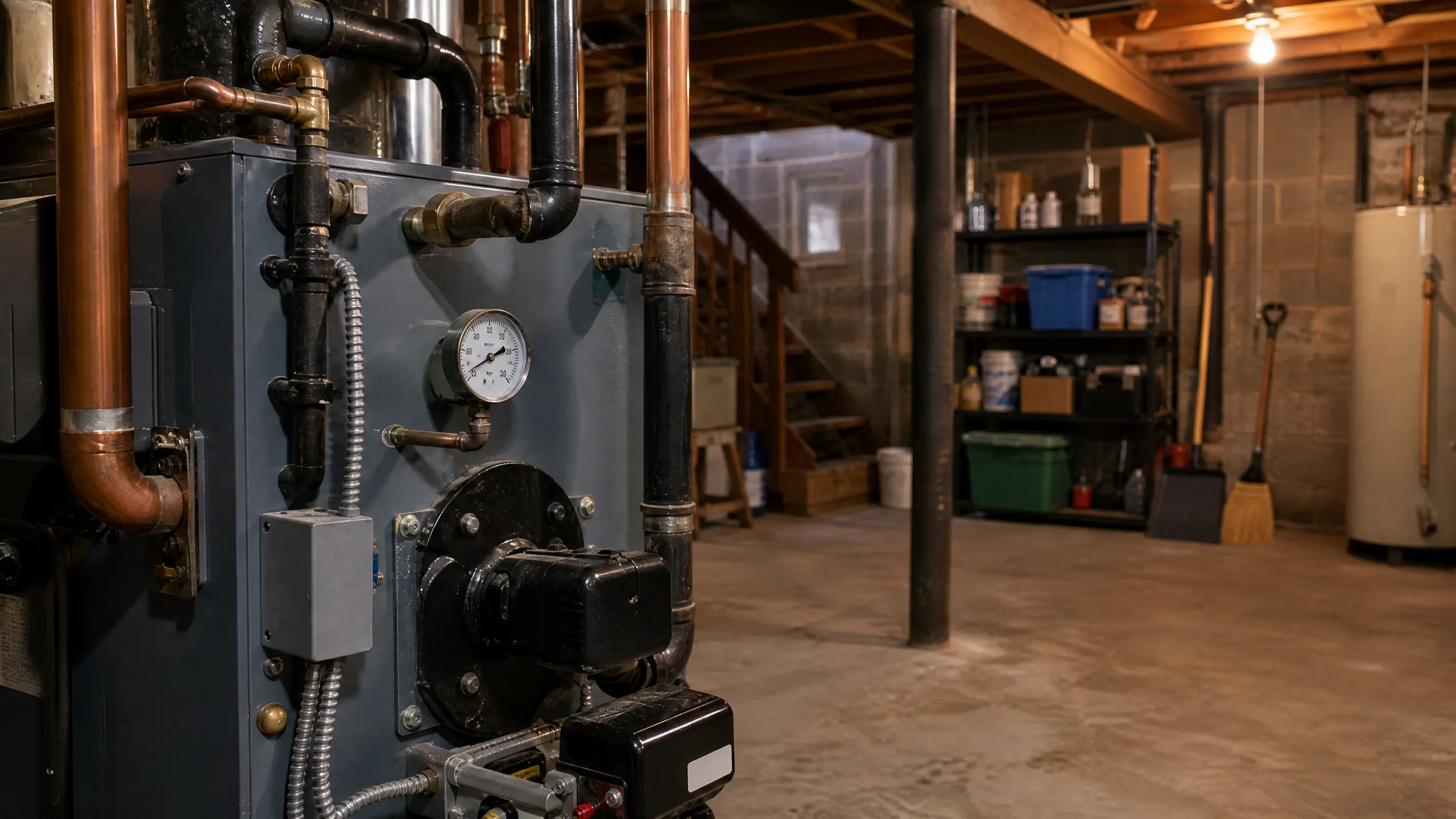




A basement mechanical room with a gray boiler connected to copper and iron pipes, a pressure gauge, and a water heater visible in the background.

Boiler Repair in Bethlehem, PA

Tell us about the job

Takes about a minute. No obligation.

Step 1 of 3: Equipment

Most boiler trouble traces back to a handful of parts. The igniter or pilot assembly wears out and stops lighting the burner reliably. A circulator pump seizes or weakens, so the boiler fires but heat doesn't move through the house the way it should. Low water pressure or a faulty pressure relief valve will shut a boiler down as a safety measure, and that's often mistaken for something more serious. Mineral buildup inside the heat exchanger is another common one, especially if the system has never been flushed, and it shows up as banging or kettling sounds before the boiler finally stops responding to the thermostat. A failed thermostat or control board can mimic almost any of these, which is why the actual cause needs eyes on the unit, not guesswork.

A boiler that bangs or kettles is already losing the fight against scale buildup on the heat exchanger.

Keep running it that way and the heat exchanger cracks, which is a repair you can't come back from.

Bethlehem gets its share of wind and winter storms. That's not why your boiler is acting up.

220 severe weather events from 2015 to 2024
15% of homes statewide lost power a day or more in 2024
172 damaging wind events from 2015 to 2024

Boilers in Bethlehem run on natural gas most of the year, and that gas cost Pennsylvania homeowners $13.12 per million Btu in 2024. That's a real reason to get a repair done right instead of running an inefficient system through another winter. A boiler that short-cycles or struggles to hold pressure burns more gas to make the same heat, and the cost shows up on the bill long before the unit fails outright. None of that means the boiler itself is under any unusual strain here. It just means a worn igniter or a weak circulator pump costs more to ignore in a place where gas isn't cheap.

If your boiler came with the house, ask how much life it has left

Half the homes in Northampton County were built in 1971 or earlier. If yours is one of them and the boiler came with the house, it may be old enough that a big repair isn't worth paying for. Get an honest answer on how many years are left in the unit before you sink money into fixing it.

Find a contractor
A man in a dark jacket, knit hat and tan work pants climbs porch steps toward a gray front door, carrying a worn canvas tool bag, with a potted shrub in a blue planter at left.

Check the pressure gauge first

Most boilers want the needle somewhere in a marked range, often a band near the middle of the gauge. If it's sitting low, the boiler may be shutting itself off on purpose rather than failing. Some models have a filling loop you can open to bring the pressure back up. If it won't hold once you've topped it off, that's a sign of a leak somewhere in the system, and that part isn't a homeowner fix.
Know what not to touch

Don't open the burner compartment or reset the control board more than once. Repeated resets can mask a flame sensor or ignition fault that needs diagnosing, not restarting. If you smell gas at any point, skip every other check, shut off the gas supply if you know how, and get out of the house before calling anyone.

Most people don't notice a boiler problem at the boiler. They notice a radiator that stays cold while the one next to it heats fine, or a hot water tap that runs lukewarm no matter how long you let it go. Some rooms heating and others not is usually airlock or a circulator that's lost strength, not a dead system. A boiler that cycles on and off every few minutes, rather than running a steady stretch and shutting off, is short-cycling, and that wears parts out faster than normal use would. Listen for it clicking into ignition and failing, trying again, failing again. That pattern points to a flame sensor or igniter on its way out, and it won't fix itself by waiting.

A tech starts by asking what the boiler's been doing, when it started, and what changed. That narrows down where to look first. Next comes the pressure gauge, then the flame or pilot assembly, then the circulator pump, checked in whatever order the symptoms point to. If the boiler short-cycles, the flame sensor and igniter get tested directly instead of guessed at. If rooms are heating unevenly, the circulator and trapped air in the system get checked instead. A combustion check often follows, because a flame that burns the wrong color or shape says something about the gas and air mixture even when the boiler seems to be running fine. By the end of the visit you should know what's failing, what fixing it involves, and whether that repair makes sense on a unit this age.