Eight months of runtime
A furnace in Luzerne County runs from October through May. That is most of the year asking the heat exchanger and igniter to cycle on and off, not a handful of cold snaps.
Takes about a minute. No obligation.
A furnace in Luzerne County runs from October through May. That is most of the year asking the heat exchanger and igniter to cycle on and off, not a handful of cold snaps.
A furnace sized for a milder county will short cycle here, and one sized too big will waste gas every month it runs. Get the load calculated for this house instead of matching the old unit's size.
NOAA nClimDiv, 1991–2020 normals
Half the homes in Luzerne County were built in 1960 or earlier.
A furnace going into a house that old has to be matched to that house, not dropped in as a like-for-like swap.




Luzerne County falls under zone 5A in the 2021 energy code, a cool zone where the furnace carries more of the year's work than the air conditioner does. That standing puts a floor under what can legally go into this house. Any gas furnace built from November 19, 2015 on has to turn at least 80 percent of its gas into heat over the winter. Furnaces built from December 18, 2028 on have to hit 95 percent, so a unit bought before that date can still be sold at the older 80 percent mark. A federal tax credit is available for qualifying high-efficiency furnaces, worth checking against whatever model gets chosen.
A furnace installed here is going to run eight months out of twelve, every year it's in service. That kind of load calls for getting the sizing and the install right the first time, not matching whatever is already in the basement.
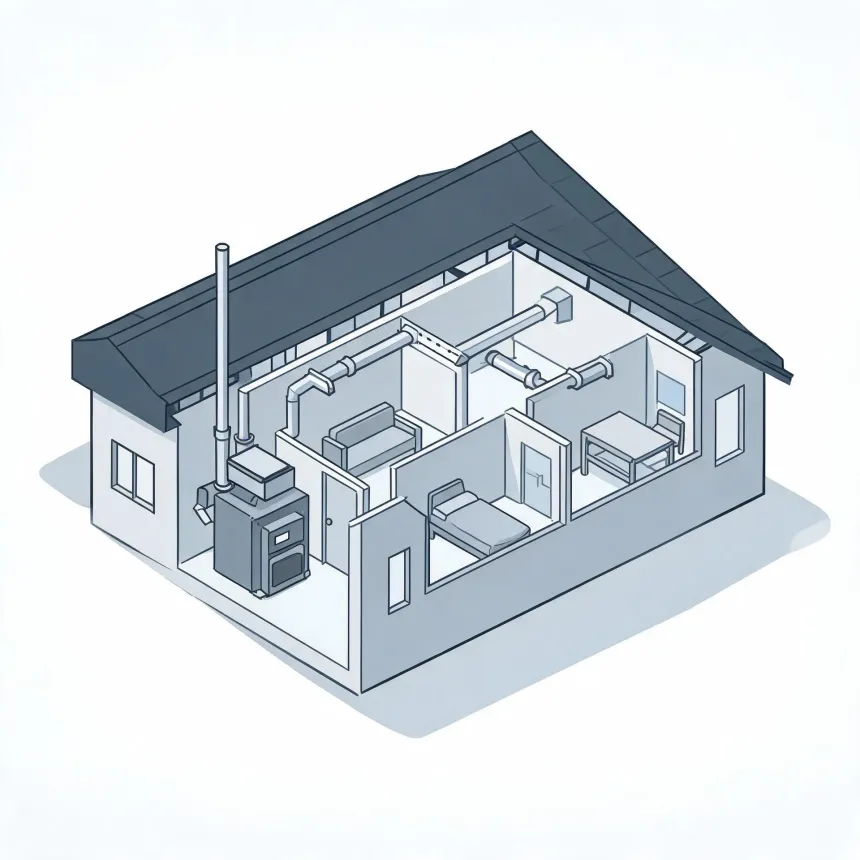
Find a contractorThe fix is to have the new furnace sized and vented for the house it's going into, not set where the old one sat because that's where the old one sat. A furnace closet and duct run built decades ago were built around whatever unit was standard then, and venting requirements have moved on since. Matching the new furnace to this house means a contractor looking at the actual space, not the old unit's specs, before anything gets installed.
The efficiency rating says how much of the gas burned turns into heat in the house versus how much goes out the flue. A higher number means less gas wasted to get the same warmth out of the registers. It has nothing to do with how big a house the furnace can heat or how fast it heats it, only how much gas it takes to do the job.
A furnace with a higher efficiency rating pulls more heat out of the exhaust before it leaves the house, which means that exhaust comes out cool enough to vent through PVC pipe instead of a metal flue. That changes where the furnace can sit and how it ties into the house, so the rating on the label isn't just a fuel question. It's a venting question the contractor has to plan for before the unit goes in.
Estimates for a typical Luzerne County home, from EIA household energy data, Pennsylvania fuel prices and NOAA climate normals. Your home will differ.
A contractor starts by pulling the old furnace and capping or rerouting whatever it leaves behind, the gas line, the vent, the duct boot. Then the new unit goes in, set on its base and leveled before anything gets connected. The gas line, the vent pipe and the ductwork all get tied in next, and each of those connections gets checked on its own before the system runs as a whole. The electrical and the thermostat wiring come after that, low voltage, simple to run but easy to get wrong if it's rushed. Once everything is connected, the furnace gets fired up and tested through a full cycle, checking the flame, the airflow and the vent draft while it runs. The last step is a combustion test with a meter, not a guess, to confirm the furnace is actually burning clean and venting the way it's supposed to before the contractor calls it done.