Two white colonial houses with lit windows and black shutters photographed at dusk along a tree-lined residential street.

Mini Split Installation in Phoenixville, PA

Tell us about the job

Takes about a minute. No obligation.

Step 1 of 3: Equipment

This county gets hit

Chester County logged 543 severe weather events between 2015 and 2024, including 478 damaging wind events, 25 hail events and 3 tornadoes. Winter storms hit 32 times in that span. An outdoor condenser sits outside through all of it.

The power doesn't always hold

15% of Pennsylvania households went at least 24 hours without power in 2024. A mini split needs electricity to run, for heat as much as for cooling, so an outage means no heat from it until the power comes back.

7 months
October through April, your system heats
3 months
June through August, it cools
25°F
the average winter night it heats against
84°F
the average summer afternoon it cools against
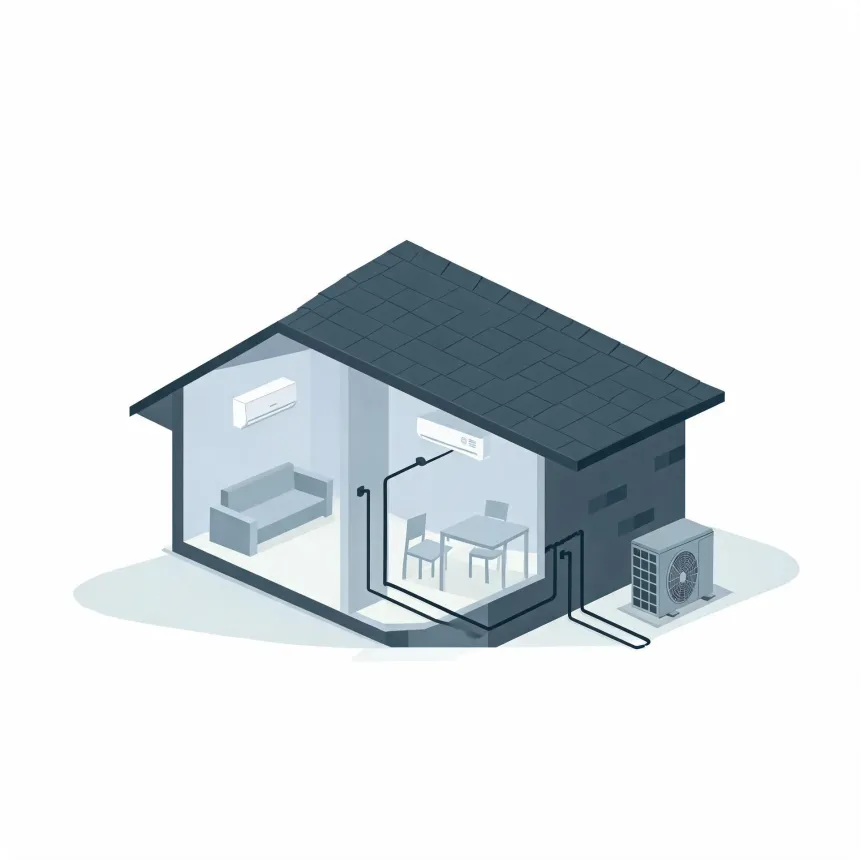
Isometric illustration of a cutaway single-story house showing two wall-mounted mini-split indoor units connected by line sets to an outdoor condenser beside the building, with a sofa, table and chairs inside.
Your system heats October through April and cools June through August.

NOAA nClimDiv, 1991–2020 normals

Cooling starts in June here.

May is the month to get a mini split installed, before the first hot stretch hits.

Electricity here runs 19.10 cents a kilowatt-hour, and a mini split that's sized and installed right earns that back every summer

Power here costs 19.10 cents per kilowatt-hour
Cooling runs June through August
Summer afternoons average 84°F

Chester County falls under climate zone 4A, a mixed zone where both heating and cooling have real work to do. Any mini-split installed here, if manufactured from 2023 on, has to meet the federal minimum for a split-system heat pump: at least 14.3 Btu of cooling for every watt-hour it draws, and at least 7.5 Btu of heat for every watt-hour in winter. That's not a target a contractor aims for. It's the floor every unit sold has to clear before it goes in a wall. The standard doesn't carve out a separate class for ductless systems, so a mini-split is held to the same number as any other split-system heat pump.

Plan the install around the weather that's coming, not just the weather today

Where the installer puts the outdoor unit, and what's mounted around it, decides how it holds up the next time wind or hail comes through. Ask about a surge protector for the system too, since that's what stands between a power spike and the electronics inside. If you're also weighing a backup power source for the house, this is the point to bring up heat and hot water, not after the unit's already on the wall.

Find a contractor

A man in a navy long-sleeve shirt and tan work pants, seen from behind, carries a canvas tool bag up light-colored porch steps toward a blue front door.
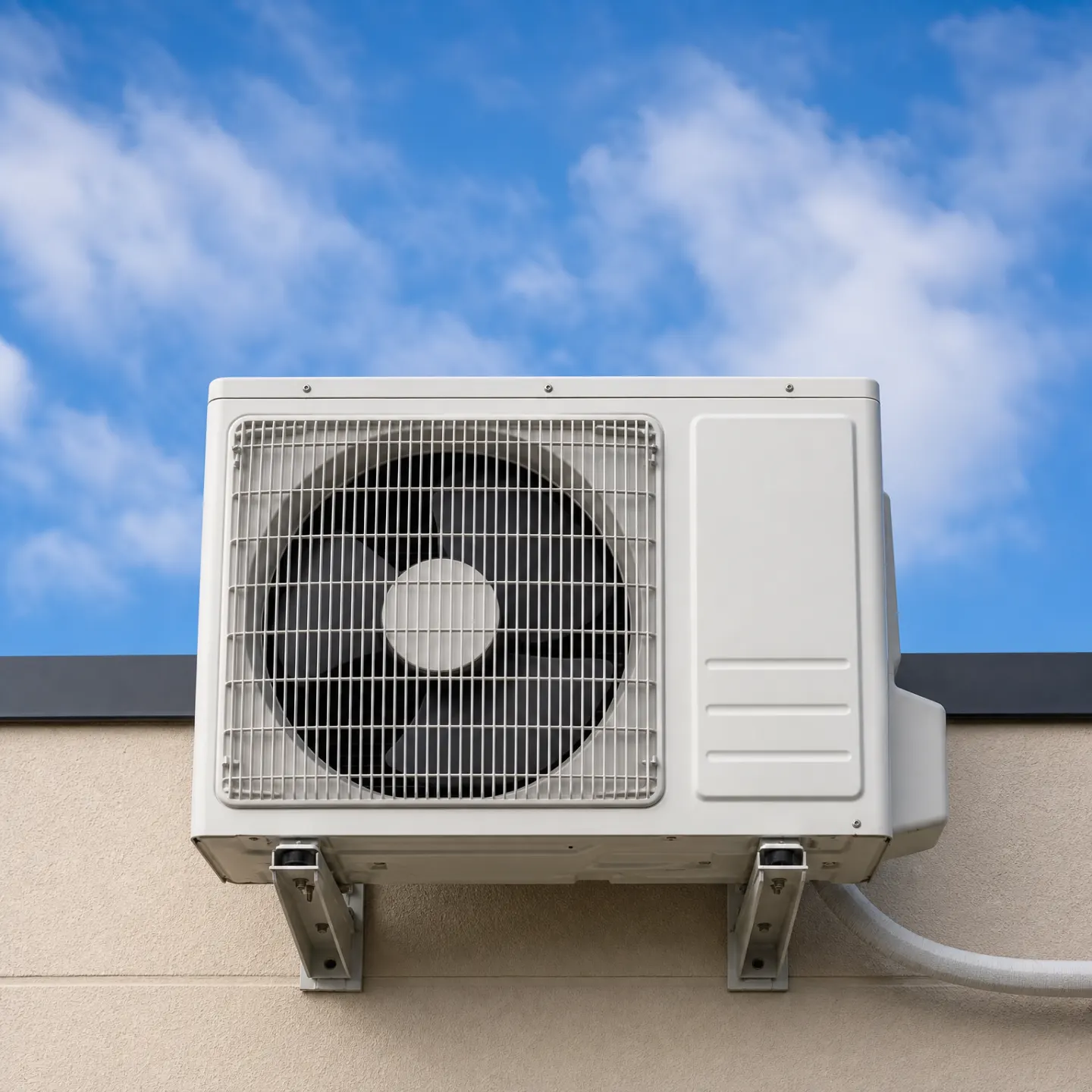
A white mini-split air conditioner outdoor condenser unit mounted on metal brackets against a beige stucco exterior wall, with a blue sky and scattered clouds in the background.

The clock never really stops on this one

A mini split runs longer than a central system ever did, because there's no ductwork cycling air through a single blower. Each indoor head switches on and off on its own, answering to the room it's in. That means more run hours across a year, not fewer. More run hours puts more cycles on the compressor and more hours on the fan motors in every indoor unit. When you compare systems, ask what the compressor is rated for and whether it's a variable-speed compressor or a single-stage one. A variable-speed compressor ramps up and down to match the load instead of switching fully on and off, and that pattern is easier on the system over years of use. Ask too how the manufacturer rates the system at low outdoor temperatures, since a heat pump has to work harder to pull heat from cold air, and some systems hold their output much better than others once it gets cold. The outdoor unit is the part exposed to everything, so ask what's involved in maintaining it: clearing debris from the coil, keeping the area around it open so air can move through freely. A system that's easy to get to for that kind of upkeep tends to get taken care of. One that's buried behind shrubs or boxed in tight usually doesn't.

The number of indoor heads sets the price

Every indoor head needs its own line set and its own power and mounting work, so a system with four rooms to cover costs more to install than one with a single head. The outdoor unit also has to be sized for the total load of every head running at once, not just the biggest room, which changes what size compressor the job calls for.

The run between units adds labor

Line sets carry refrigerant between the outdoor unit and each indoor head, and they have to be run through walls, up exterior siding, or along a chase built to hide them. A short, straight run is quick work. A run that has to clear framing, turn corners, or cross a finished ceiling takes more time and more material, and that labor is where the price moves.

Utility gas heats 35.9% of homes in Chester County, more than any other fuel, with electricity next at 31.1% and the rest split between oil and propane. A mini split runs on electricity regardless of what heats the rest of the house, so it doesn't replace a gas furnace so much as take over the job of heating and cooling a space on its own circuit. That's worth knowing going in, because the cold-weather performance of the heat pump matters here the same way it would if electricity were the only thing in the house keeping it warm. Whether the rest of the home runs on gas, oil or propane doesn't change what the mini split has to handle once it's on the wall.

That gap between a cheap unit and an efficient one shows up on the bill faster here than somewhere power is cheap, so it's worth asking for the SEER2 number before deciding on a system. A higher SEER2 means less pulled from the meter for the same cooling. Ask the installer to size the system for how it'll actually be used, since a unit covering one room a few months a year gets specified differently than one expected to carry a space through the whole stretch of hot weather. Say upfront what the room is for and how much it'll run. That changes which unit makes sense, and it changes what you'd see on a bill after it's in.