Electricity here runs 19.12 cents a kilowatt-hour
That is higher than what most US counties pay. A mini-split runs on electricity alone, so every hour it runs draws power at that rate.
Takes about a minute. No obligation.
That is higher than what most US counties pay. A mini-split runs on electricity alone, so every hour it runs draws power at that rate.
A mini-split's job is to move heat, not fight it, and how well it does that for its size is what the rating on the unit tells you. In a county paying this much per kilowatt-hour, that number carries more weight than it would somewhere power is cheap.
NOAA nClimDiv, 1991–2020 normals
Cooling runs June through September here.
Get a mini-split installed before June and it's working on day one of the heat, not day three of a heat wave.



Gas heats close to 7 in 10 homes in Philadelphia County. In a house like that, a mini-split is rarely the only thing keeping you warm or cool. It usually goes in for cooling, or to handle a room the furnace doesn't reach well, like a finished attic or a room added on later. About a quarter of homes here run on electric heat alone, and in those houses a mini-split can take on more of the job, sometimes the whole thing. Knowing which kind of home yours is changes what you're asking the installer to size it for.
Power here costs more than in most places, so the rating on the unit you install is doing real work on your bill every time it runs. Ask the installer which rating fits this job before you decide.
Find a contractor
Half the homes here were built in 1949 or earlier. A house that old has likely seen an addition, a finished basement, or walls opened up for other work since. None of that is something to guess at from here. What it means for this job is that sizing has to go room by room, not off a chart for the square footage. An installer who comes out to measure, not just quote from a listing, is the one who gets the unit right for the space you actually have.
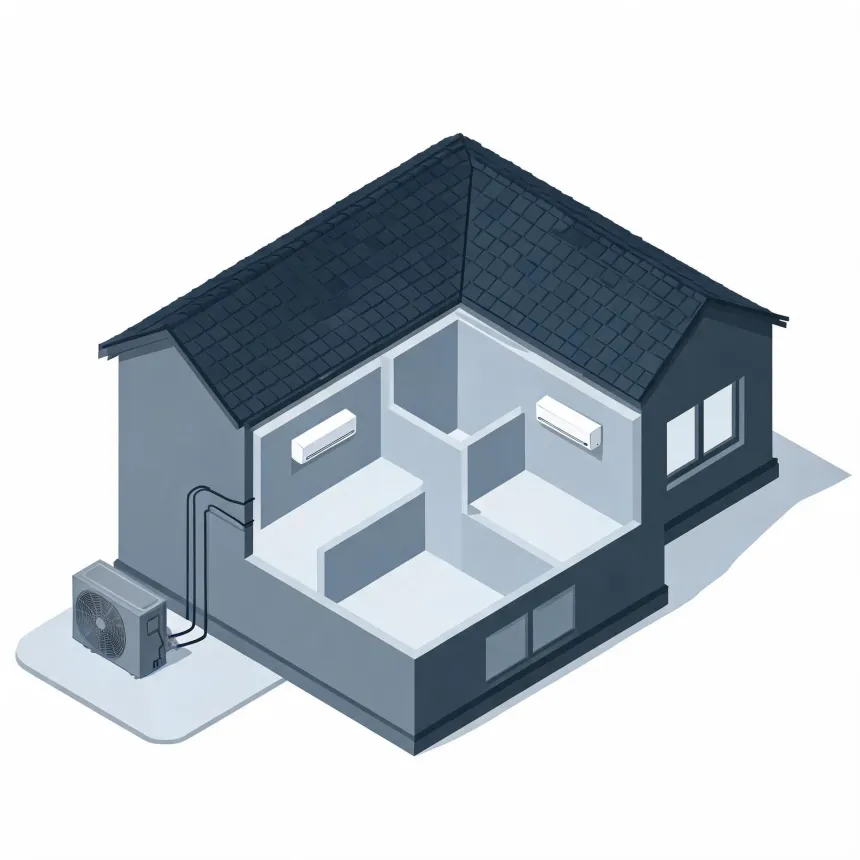
A mini-split is priced per zone, and every indoor head needs its own line set and its own spot on the wall or ceiling. One room is a straightforward job. Four rooms means four line sets, four mounting points, and a condenser sized to carry all of them. The more zones you want, the more that adds up before anyone talks about the equipment itself.
Refrigerant lines run from the outdoor condenser to each indoor head through a hole drilled in the wall, and every foot they travel has to be set, insulated, and sealed. A condenser placed right outside the room it serves is a short run. One on the far side of the house, or a unit going in upstairs, means longer line sets, more wall penetrations, and more time on the ladder. The distance between where the condenser can sit and where the head needs to go is doing more to the price than the equipment is.
Sizing a mini-split starts with a heat load calculation, not a tape measure around the room. The math accounts for the size of the room, how many walls face outside, what's above and below it, window area, and what direction those windows face. Square footage alone leaves out all of that, which is why two rooms the same size can need different size heads. Oversize the unit and it cools the room fast, shuts off, and runs short cycles all day, which leaves the space feeling damp because it never runs long enough to pull moisture out of the air. Undersize it and it runs constantly, struggling to catch up on the hottest or coldest days without ever getting there. The right size runs longer, steadier cycles, and that's what actually keeps a room comfortable.
Philadelphia County falls in climate zone 4A, a mixed zone that asks real work of both heating and cooling through the year. Any split-system heat pump sold here, mini-splits included, has to meet a federal minimum under that standard: units built from January 2023 onward need to deliver at least 14.3 Btu of cooling and 7.5 Btu of heating for every watt-hour they draw. That is not a target to aim for, it is the floor. A unit that clears it by a wide margin may also qualify for a federal tax credit, worth checking before you settle on equipment. Either way, the rating on the spec sheet is not optional reading here.