





A two-story red brick house with a dark roof and white-trimmed windows sits on a lawn behind a stone retaining wall, framed by large leafy trees under an overcast sky.

Boiler Repair in New Castle, PA

Tell us about the job

Takes about a minute. No obligation.

Step 1 of 3: Equipment

Boilers in Lawrence County sit idle most of the summer, then get asked to run every day starting in October. That first stretch of real cold is when a weak igniter or a failing circulator pump finally gives out. If yours is making noise or not holding heat, September is the month to get it looked at, before it has to run eight months straight. A problem caught before October is usually a smaller job than the same problem found in the middle of a cold snap.

Boilers in Lawrence County run about eight months a year, October through May.

An eight month season is normal wear. A boiler breaking down still points to a worn part, not the weather.

Half the homes in Lawrence County were built in 1957 or earlier

Half the homes here were built by 1957
Heat runs October through May
Winter nights average 22°F
Weather isn't the problem hereLawrence County saw 206 severe weather events from 2015 to 2024. Boilers still fail from worn parts, not storms.

A boiler running on natural gas in New Castle costs what it costs based on gas prices here, and Pennsylvania homes paid $13.12 per million Btu in 2024. That number matters when you're deciding whether to repair or let a problem sit. A boiler that's short cycling or losing pressure isn't running efficiently, and every month it runs that way costs more than the repair would. It's not a sign of a bigger problem, just a part doing its job poorly until someone replaces it. Getting the actual cause fixed, whether that's a pressure valve or a failing circulator, stops the waste right away.

Ask how much life is left before you pay for the repair

If your boiler came with a house built in 1957 or earlier, age may be part of what's going on. Ask whoever looks at it how much life is left before you pay for the repair. A worn part is still a worn part, but on an old unit it may be the last one worth replacing instead of fixing.

Find a contractor
A man in a dark cap, dark shirt and tan pants, seen from behind, carries a canvas tool bag up concrete steps toward a blue front door, with a potted green plant in a blue planter beside the entry.

Noise means a part is struggling

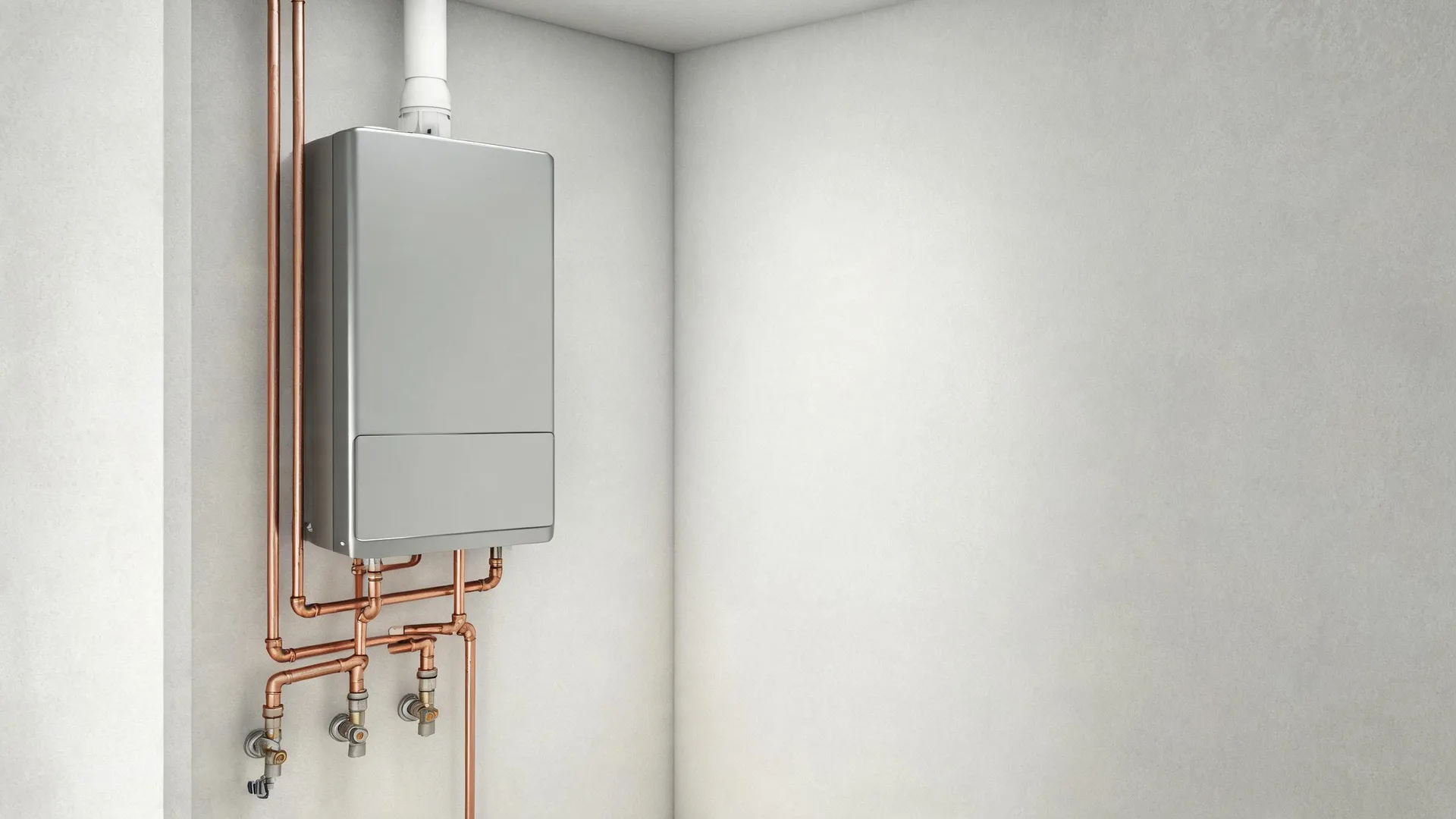
A boiler should run close to silent. Kettling or a rumble from the heat exchanger means scale or sediment is making the water boil in spots before it circulates. Banging in the pipes often means trapped air or a failing valve. A low hum that wasn't there before can point to a circulator pump wearing out. None of these go away on their own, and running the boiler while the noise continues usually just wears the part out faster.
No heat or uneven heat is a diagnosis, not a mystery

If radiators or baseboards stay cold while the boiler runs, check whether it's every room or just some. All of them cold points to the circulator pump, a failed igniter, or low pressure. Some rooms cold and others fine usually means a stuck zone valve or air trapped in that loop. A pilot or igniter that won't hold a flame is a safety component doing its job, not a part to force past. Either way, the pattern of what's cold and what isn't tells a tech most of what they need before they even open the panel.

Before calling anyone, check the pressure gauge on the front of the boiler. It has a marked range right on the dial, and if the needle sits below it, the fix might be as simple as the feed valve. Check the floor around the boiler for water. A puddle means a leak somewhere in the system, and that needs a tech no matter what else is going on. If there's a viewing window, look at the flame. It should burn steady and blue, not yellow or flickering. Flip the breaker for the unit off and back on. A reset solves more than people expect, but if the problem comes right back, that's information for the tech, not a reason to keep resetting it.

A boiler is made up of parts that get swapped on their own. A circulator pump, an igniter, a pressure valve, a control board. Most repairs replace one of those without touching the rest, and that's usually worth doing, since none of them have any bearing on whether the heat exchanger or the tank itself is still sound. What changes the math is when the problem is in the heat exchanger or the tank. Those aren't practical to repair, so a leak or crack in either one usually means the unit is done. The other thing worth asking is how many repairs this same boiler has needed in the last couple years. One fixed part is normal wear. A string of different parts failing one after another means the boiler is wearing out everywhere at once, and the next repair is just a guess at which part goes next.