

A row of illuminated white colonial houses with black shutters and a stone wall along a road at dusk.

Boiler Installation in Pittsburgh, PA

Tell us about the job

Takes about a minute. No obligation.

Step 1 of 3: Equipment

Allegheny County saw 690 severe weather events between 2015 and 2024. That includes 548 cases of damaging wind, 115 hail events, and 12 tornadoes. A boiler itself sits indoors, but the power it runs on doesn't always hold up through a storm like that. Statewide, 15% of households went at least a day without power in 2024. A boiler without power won't fire, gas or no gas, so a storm that knocks out electricity can leave a house without heat even though the system itself is fine.

Gas heats 80.5% of homes in Allegheny County, more than any other fuel.

A gas boiler replacing a gas system fits pipes and venting that are already there.

Half these homes predate the system you're replacing

Half the homes here were built by 1957
Heat runs October through May
Winter nights average 24°F

Allegheny County falls in climate zone 5A, a zone where heating does more work than cooling over the year. Any gas boiler installed here has to meet the federal minimum for that fuel type: at least 84 percent of the gas it burns has to turn into heat over the season, for units built from January 2021 on. That rule narrows the field before you even start comparing brands. A boiler rated below that line can't legally go into a new installation, so what you're choosing from is already the more efficient half of what's out there.

Plan this boiler to survive a power cut, not just a cold snap

Ask what happens to this boiler when the power drops. Battery backup or a manual override can keep it firing through an outage, and it's worth asking the installer what that costs to add now, while the system is being put in.

Find a contractor
A man in a cap, dark long-sleeved shirt and brown work pants carries a canvas tool bag up porch steps toward a blue front door, with a shrub in a blue planter beside it.

The rating only holds if the boiler is sized right

A high efficiency rating assumes the boiler matches the heat loss of the house it's in. One that's too big cycles on and off instead of running steady, and short cycling wears the heat exchanger and the igniter faster than steady runs do. A contractor should size the unit off a heat loss calculation, not just swap in something close to the old one.
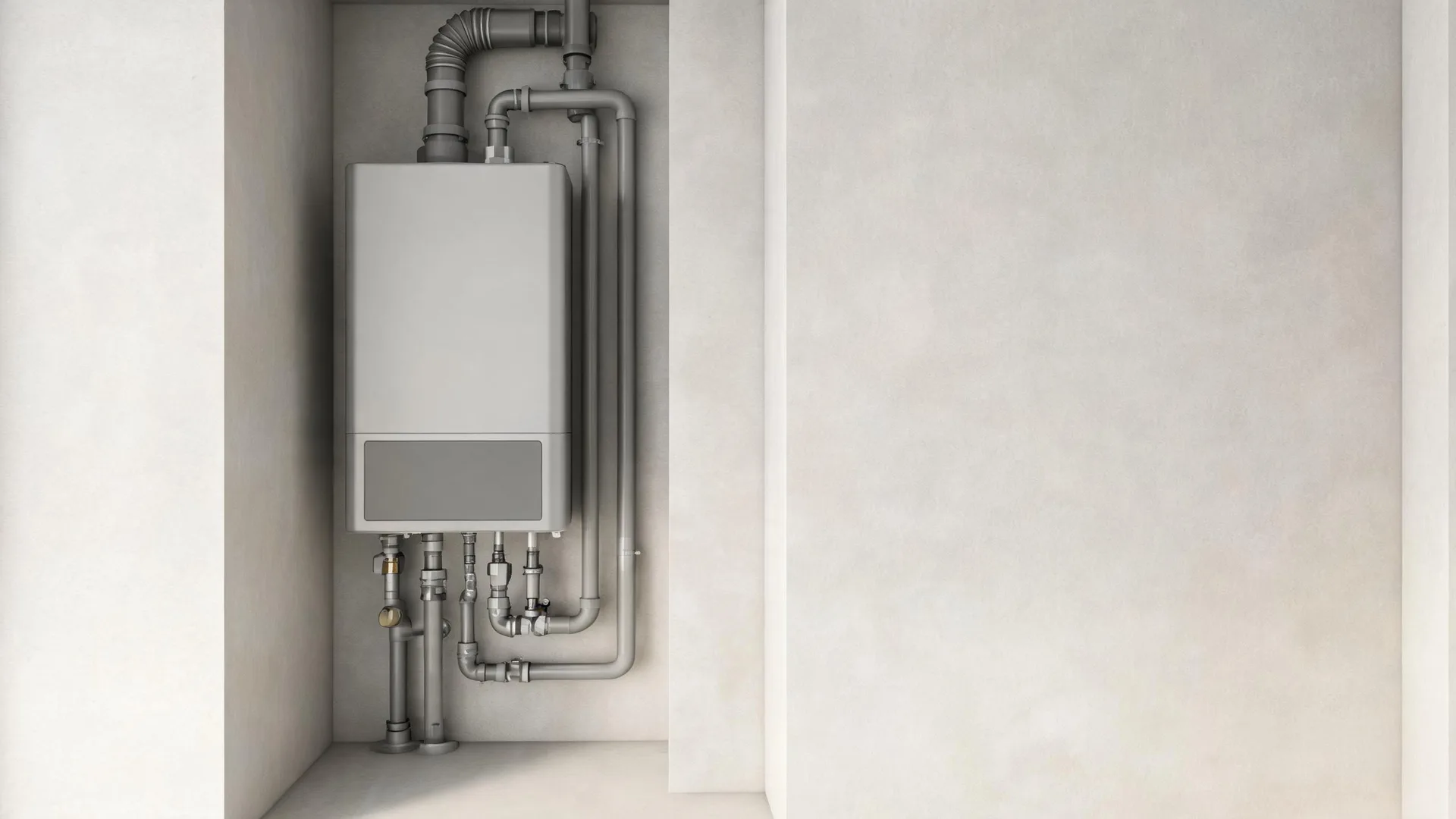
A condensing boiler needs somewhere for the condensate to go

The higher the efficiency, the more moisture the boiler pulls out of the flue gas as it cools it down. That water has to drain somewhere, through a condensate pump or a gravity line to a drain. Skipping that part of the install, or routing it wrong, leads to a boiler that trips its own safety switch and shuts down.

Pulling the old boiler is usually straightforward. The water gets drained from the system first, through a valve at the bottom of the tank, and the gas and water lines get disconnected before the unit comes out. If the old boiler vented into a chimney, that chimney often needs a liner afterward. A smaller flue from a high efficiency boiler can let a masonry chimney cool enough for moisture to collect, and that moisture breaks the liner down over time. Whatever hauls the old unit away should also deal with whatever was in it. Older boilers sometimes hold water treated with chemicals that shouldn't go down a drain or into the yard. A contractor who's done this before will know what's safe to drain and what has to be disposed of separately.

Heat runs here from October through May, about eight months of the year. That leaves a narrow window to get a new boiler in before it has to carry the house through winter. September is the month to have it done, not the month to start calling around. A boiler installed in a hurry gets sized and vented the same as one installed with time to spare, but the mistakes are more likely to slip through when the old one just quit and the house is already cold. Doing it in September means the install gets checked, tested, and run for a few weeks before it has to hold a house at 24 degrees overnight.