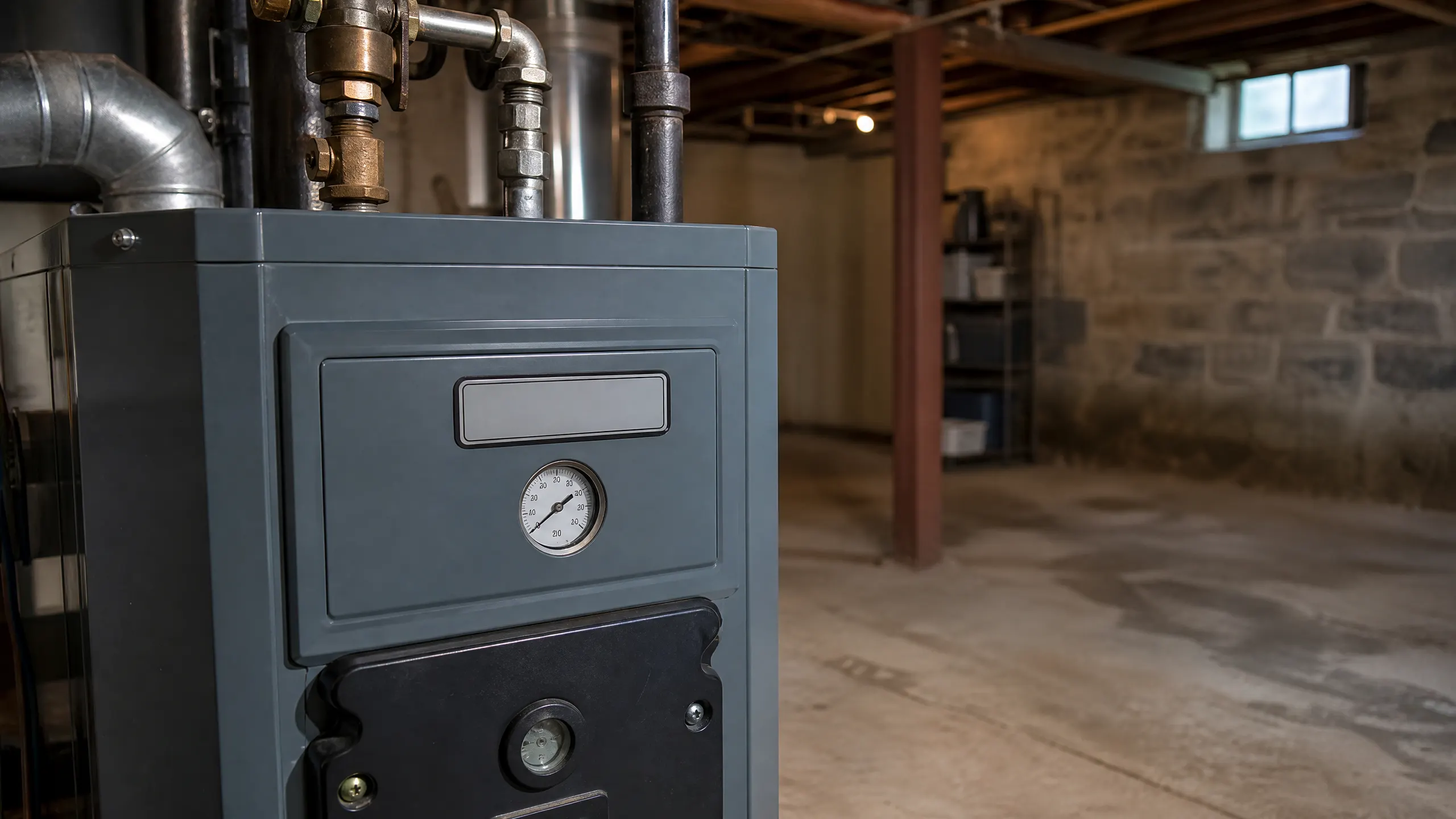
A gray residential boiler with brass pipe connections and pressure gauges installed in an unfinished stone-walled basement.

Boiler Installation in Norristown, PA

Tell us about the job

Takes about a minute. No obligation.

Step 1 of 3: Equipment

Storms hit this county often

Montgomery County recorded 458 severe weather events between 2015 and 2024, including 351 damaging wind events, 59 hail events, and 35 winter storms. A boiler installed here has to stand up to weather, not just run on a mild day.


Power doesn't always hold

15% of Pennsylvania households went at least 24 hours without power in 2024. A boiler with no backup plan for that stops making heat and hot water right when a cold snap or ice storm knocks the lines down.

Gas heats most homes in Montgomery County, more than half of them.

A boiler installation here is usually swapping one gas boiler for a better one, not rethinking the fuel.

Gas here is cheap, so the payback math on a high-efficiency boiler changes

Climate zone 4A
Heat runs October through April
Winter nights average 25°F
Older Homes, Different Boiler NeedsHalf the homes in Montgomery County were built in 1971 or earlier.

Montgomery County falls under zone 4A of the 2021 energy code, a mixed climate that works both the heating and cooling sides of a system hard. That classification sets a floor for what can go into a home here. Any gas-fired hot water boiler built on or after January 15, 2021 has to turn at least 84 percent of the gas it burns into heat over the season. That's not a marketing number, it's the minimum a new unit is allowed to hit. A homeowner comparing models in Norristown can rule out anything that falls short before looking at price. There's also a federal tax credit available on qualifying high-efficiency equipment, worth checking against whatever model ends up on the table.

Plan this boiler around the outages, not just the cold

A boiler going in now is a chance to plan for the outages that come with storms here. Ask about battery or generator backup so the system can still fire up when the power drops, and have the installer walk through where the vent and any outdoor components sit so wind and ice don't put them out of reach right when you need heat most.

Find a contractor

The boiler itself is one line item

A cast iron boiler costs more than a steel one and tends to outlast it. Condensing models cost more up front than conventional ones because they carry a second heat exchanger to wring extra heat out of the exhaust before it leaves the vent. Output has to match the home's heat loss, not the old boiler's size. Oversizing it doesn't buy comfort, it just adds to the price tag.

Most of the bill is the work around it

Venting drives a lot of the cost. A conventional boiler vents through a chimney, while a condensing boiler vents through a wall or roof with new pipe, and running that pipe is labor. Piping, the expansion tank, the circulator pump, and gas line work all add hours. If the old boiler fed radiators or baseboard that stay as they are, that keeps the job simpler than a system that also needs new zoning or controls.

A boiler has to be sized to the house, not picked off a shelf. That means a heat loss calculation, room by room, that looks at square footage, ceiling height, window area, insulation, and how much of the outside wall is exposed. The old boiler's size tells you nothing, since it may have been oversized to begin with or chosen to cover a house that's since been insulated or added onto. Too big and the boiler short cycles, firing up, satisfying the thermostat fast, then shutting off again before it runs long enough to reach steady efficiency. That wears the burner and the ignition system harder over time and still leaves rooms feeling uneven. Too small and it runs long stretches without catching up on the coldest days. The right size is the one that matches the heat the house actually loses, which is why a contractor doing this properly measures the house instead of matching the nameplate on the unit being replaced.

Heat here starts up in October. That gives a homeowner replacing a boiler now a stretch of time to get it done before the burner has to carry the house. A failed boiler in January means picking from whatever's in stock and getting it in fast. One replaced in September gets sized properly, vented properly, and tested before it has to do real work. The boiler installed this fall is the one that runs for the next seven months, October through April, so there's no reason to rush a decision that long-lived.