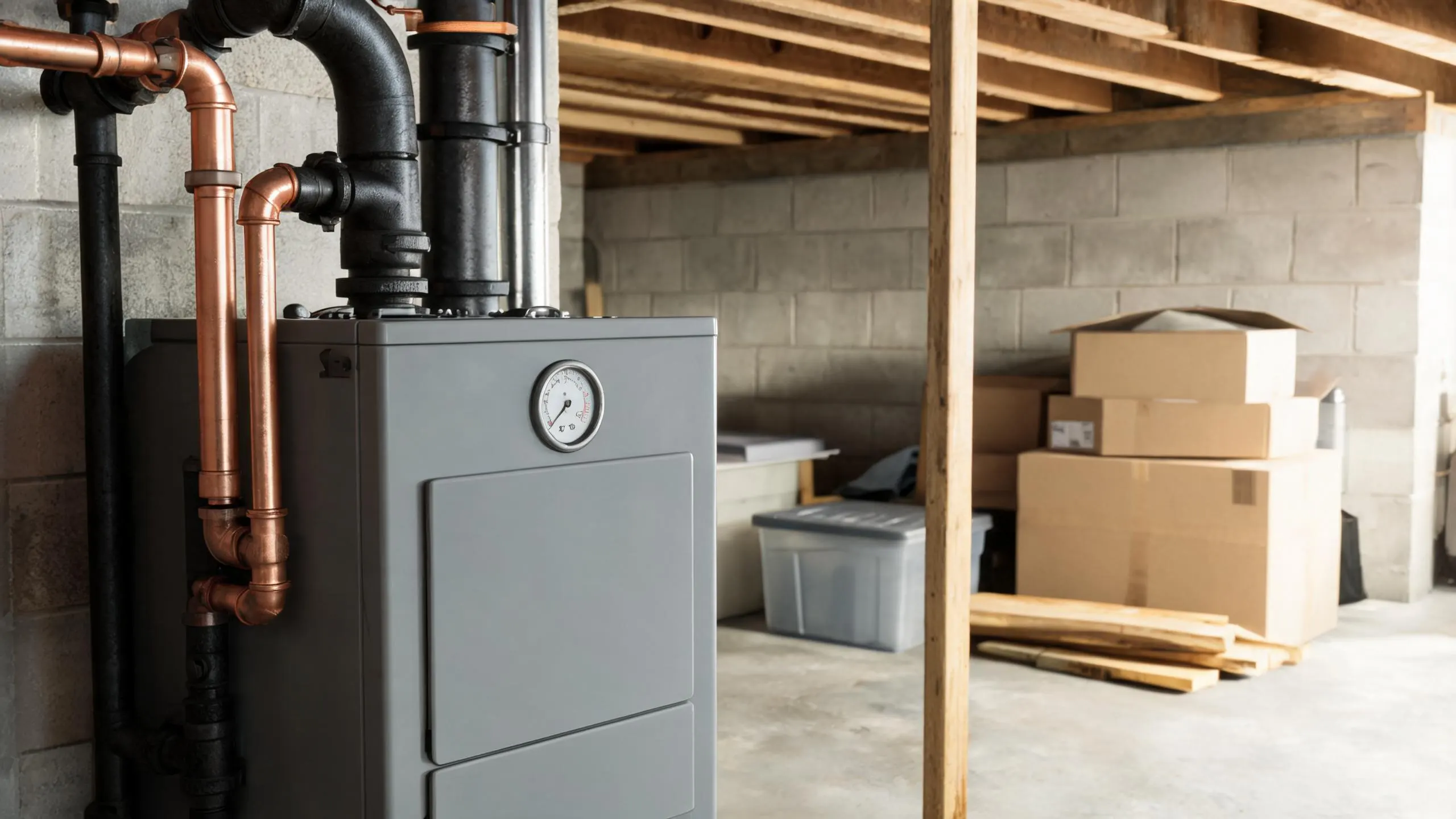





A gray boiler with copper and black piping mounted against a concrete block wall in an unfinished basement.

Boiler Repair in Washington, PA

Tell us about the job

Takes about a minute. No obligation.

Step 1 of 3: Equipment

A boiler doesn't sit outside where hail or wind can get at it, but the power behind it runs through the same storms as everyone else's. Washington County logged 344 severe weather events between 2015 and 2024, and 263 of those were damaging wind. Wind like that takes down lines. When the power goes, a gas boiler without a standing pilot won't fire, no matter how sound the rest of it is. Statewide, 15 percent of Pennsylvania households went at least a day without power in 2024. A boiler that cuts out for a day in the middle of winter isn't a small problem.

A boiler that bangs, gurgles, or kettles is telling you the heat exchanger is already working harder than it should.

Left alone, that strain is what cracks a heat exchanger instead of just wearing a part you could have replaced.

Half the boilers here are as old as the house

Half the homes here were built by 1966
Climate zone 5A
Heat runs October through May
Built for weeks the power can't touchHeat starts in October here and runs through May, so a boiler gets no warm stretch to limp along in.

Half the homes in Washington County went up in 1966 or earlier. If yours is one of them and the boiler has never been swapped out, you're dealing with a machine that has been running since before most of today's parts and codes existed. Ask the contractor straight out how much life is left in it before you pay for the repair. On a boiler that old, a cracked heat exchanger or a failed block is usually a sign to replace rather than fix. A newer boiler in an older house is a different conversation, one worth having with whoever comes out to look at it.

Make sure it comes back on when the power does

If a power cut has knocked the boiler out before, or you're not sure it would restart on its own, get it looked at now rather than on the next cold night. A quick check now is a smaller job than a no-heat call once the power is back and the temperature isn't.

Find a contractor
A man in a cap, navy T-shirt and brown pants carries a waxed canvas tool bag up the steps toward a blue front door of a shingled house, beside a potted shrub.

Ignoring a leak lets it spread

A boiler weeping water at a fitting or valve doesn't stay small. That moisture reaches the burner compartment or the electrical connections and causes a failure that has nothing to do with where the leak started. What would have been a new gasket or valve turns into a burner assembly or control board.
A limping boiler still needs a full look

If the boiler is firing and holding pressure, it's tempting to wait. But a short cycle, a pressure drop, or a pilot that won't hold are often the early sign of a problem that's still cheap to fix. Call it in when you notice it, not after it quits on a cold morning.

Before anyone comes out, look at the pressure gauge. It should sit somewhere in the gauge's marked range while the system is cold. If the needle has dropped below that, the system has lost water somewhere, and topping it off through the feed valve might be enough to get it running again. While you're down there, check the floor and the fittings for any dampness or white mineral crust, since that points to a leak rather than a pressure problem. Check the thermostat too. A dead battery or a setting bumped out of place looks exactly like a boiler that won't respond. If the boiler has a standing pilot, see whether it's still lit. None of this fixes a cracked heat exchanger or a failed control board, but it tells you whether the problem is something small or something that needs a call right away.

A repair makes sense when the problem is one part doing its job badly: an igniter that won't glow, a circulator pump that's seized, a zone valve stuck shut. Those fail on their own, without taking the rest of the system down with them, and swapping the part brings the boiler back to where it was before. Replacement enters the picture when the failure is in something the boiler only has one of, like the heat exchanger or the cast iron block itself. Those aren't sold as spare parts because they're not meant to fail alone, and when one does, it usually means years of heat and pressure have already worn the whole unit down, not just that one piece. The other thing worth weighing is what the repair actually buys back. Fixing a part on a boiler that's otherwise sound gets you years of normal running. Fixing the same part on a boiler that's already losing efficiency or needs something new every season just gets you back to where you were, waiting on the next failure.